Reflection made visible in surface, gesture, and form
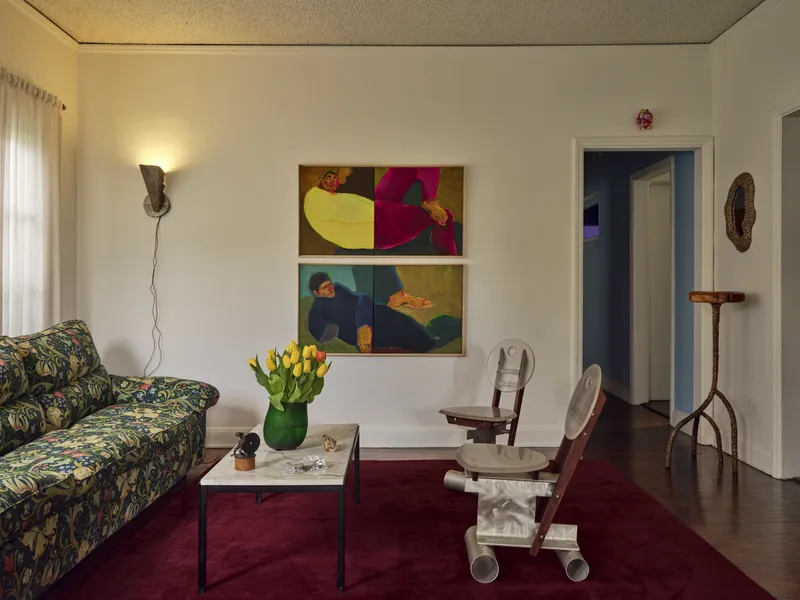
Rhett Baruch Gallery: The Apartment is pleased to present The Weight Of Thinking, a two-person exhibition featuring new works by Copenhagen-based painter Lasse Bech Martinussen and Los Angeles-based artist and designer James Naish. Both artists approach material and form with an awareness of history by echoing Auguste Rodin, Henry Moore, Matisse, Giacometti, etc, while making space for contemporary questions of masculinity, process, and transformation. The exhibition considers how sculpture, whether cast in bronze or imagined in paint, can embody thought itself: reflection made visible in surface, gesture, and form. It stages a dialogue between visual representational weight in Martinussen’s painted figures and literal, material weight in Naish’s forged and cast works. The exhibition foregrounds the act of thinking as both a psychological and physical condition, articulating the dialectic between internalized reflection and externalized, tangible form.
Martinussen’s 'Thinking Men' series engages with the historical lineage of the figure in art, invoking references from classical antiquity to Rodin’s sculptural idiom, while interrogating contemporary constructions of masculinity. The majority of the sculptural sources that inform Martinussen’s formal vocabulary historical works by Henri Matisse, Henry Moore, and Barbara Hepworth were conceived as female bodies or feminized abstractions. By appropriating their compositional strategies and applying them to male subjects, Martinussen inverts an art-historical tradition, producing a “sculptural masculinity” that is both monumental and vulnerable. His paintings, with their visible brushwork and exposed underlayers, emphasize process as a metaphor for interiority, registering the act of thought as an embodied state.
Naish’s practice spans mirrors, sculptures, and candleholders that operate between abstraction and figuration. Through welding, casting, forging, and carving, his accumulative processes produce richly textured surfaces that reveal the materiality of metal as both medium and subject. Each weld is celebrated rather than concealed and functions simultaneously as structure and gesture.. His works explore hybridity, transformation, and accretion, situating the industrial and the organic within a single continuum.
By invoking Rodin’s Gates of Hell as a conceptual touchstone, yet reorienting the metaphor toward the possibility of “heavenly gates,” the exhibition reimagines thresholds not as sites of torment, but as portals of beauty, creation, and transcendence.